Measuring What Matters: Personal Outcome Measures at CVNQuinte
Part 2 of 2
Asking the Difficult Questions
In Part One of this series, we followed Brian to the Belleville Model Railroad Club and to his church community: two places where he is known, valued, and glad to be. His story is a window into CVNQuinte’s approach to Building Context for Relationship.
But how does CVNQuinte know whether that approach is actually working? How does the agency measure whether the people it supports are living well and not just receiving services, but genuinely thriving?
The answer lies in a tool called Personal Outcome Measures, developed by the Council on Quality and Leadership. Understanding how it works helps explain why stories like Brian’s and Patrick’s, explored below, are not accidents but represent genuinely intentional results of applying a planned approach.
“We use the tool because we know it’s the highest quality of evaluation,” explains Executive Director Terri Korkush. “It really gives us not just a feeling of ‘oh, I think we’re doing okay.’ We actually have data to support the quality of work that we provide.”
A Tool Built Around the Person
Terri Korkush, Executive Director of CVNQuinte, has been using Personal Outcome Measures since 1999. She describes it as the only tool she knows of that evaluates not just the quality of services an agency provides, but the actual quality of a person’s life.
“We use the tool because we know it’s the highest quality of evaluation,” she says. “It really gives us not just a feeling of ‘oh, I think we’re doing okay.’ We actually have data to support the quality of work that we provide.”
The framework covers 21 outcomes across five domains, spanning a wide range of observable qualities including human security, community, relationships, choices, and personal goals. The questions yield data across a spectrum, from whether someone is safe and free from abuse, to whether they have friends, perform social roles, and are realizing goals that matter to them.
Coordinators conduct these interviews with the people CVNQuinte supports, then sit with them to talk through what the results reveal. “The Coordinator meets with the person to talk about priorities. We discovered things are going really well in someone’s life. And things that are not so good,” she explains. “We ask ‘What would you like to be working on?’ and then we start to put into place resources around those outcomes.”
The data serves a second purpose beyond the individual. Across the agency’s interviews, patterns emerge to inform areas where CVNQuinte as a whole may be falling short and where the majority of people need more support.
“We’re able to see which of those 21 outcome areas, as an agency, might be lacking in our support and services for people,” Terri explains. “And that’s where “Building a Context for Relationship” came into play [see this related feature]. Whenever you’re doing these types of interviews and looking at the evaluation and the analysis, the two toughest things for people to achieve are friendships and social roles.”
Outcomes 13 and 16 in the framework — people have friends, and people perform different social roles — consistently prove the hardest to achieve. That gap is what drove CVNQuinte to build their BCR practice created by Janet Klees. The data pointed to the need and the framework provided the path.
What the Numbers Look Like in a Life
Patrick is 78 years old. For much of his life, the world outside his apartment was largely inaccessible to him. He didn’t go anywhere. He didn’t connect with anyone beyond the people paid to support him.
That began to change in his early 70s, through a sequence of events that nobody planned.
When Patrick was facing an urgent move from his building, a firefighter named John was among the crew that came to speak with the residents. He noticed Patrick was wearing a Homer Simpson shirt, and they had a conversation. Weeks later, John delivered a Homer Simpson collectible to the agency and asked if it could get to Patrick.
Jasmine Gray, then a coordinator working with Patrick, recognized that moment for what it was.
“When somebody gives you a gift, normally you give them a thank you card, or you go say thank you in person,” says Jasmine. “So we took that opportunity to ask, ‘hey Patrick, should we go to the fire hall and just say thank you? That was a really nice thing to do.’”
They went. The reception was warm. And for Patrick, something clicked.
“Patrick is somebody who loves authority figures,” Jasmine recounts. “He’ll tell you all the time, ‘I want to have meetings with the big shots.’ And he views people of authority as people who are very important. So to him, going to say thank you at the firehall and seeing how receptive everybody was and how welcoming they were made him feel really important.”
Jasmine saw the potential immediately. “It was very obvious that it was going to be a good connection. And so I tried to work really hard at continuing that for him, because I knew it was going to grow into something that was going to be really special.”
A Friendship That Grew
Joanne Goodfellow, a supervisor at CVNQuinte who has known Patrick for many years, watched the relationship with the fire department unfold over time.
Patrick began visiting regularly, bringing treats each time.
“So different things came about from this relationship. He continued to take small treats as a gesture to them,” remembers Joanne, “and they continued to make Patrick more and more part of their fire department.”
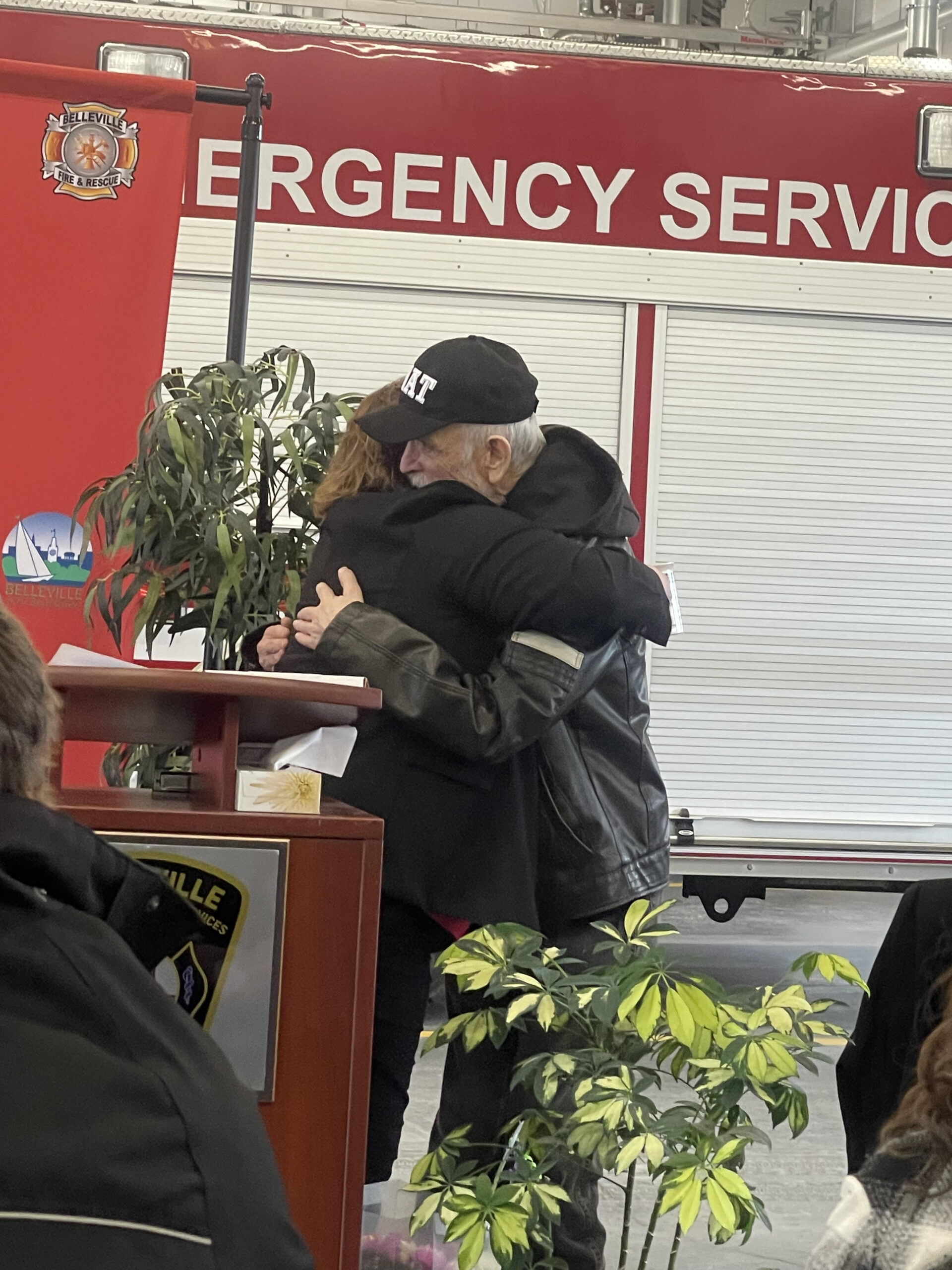
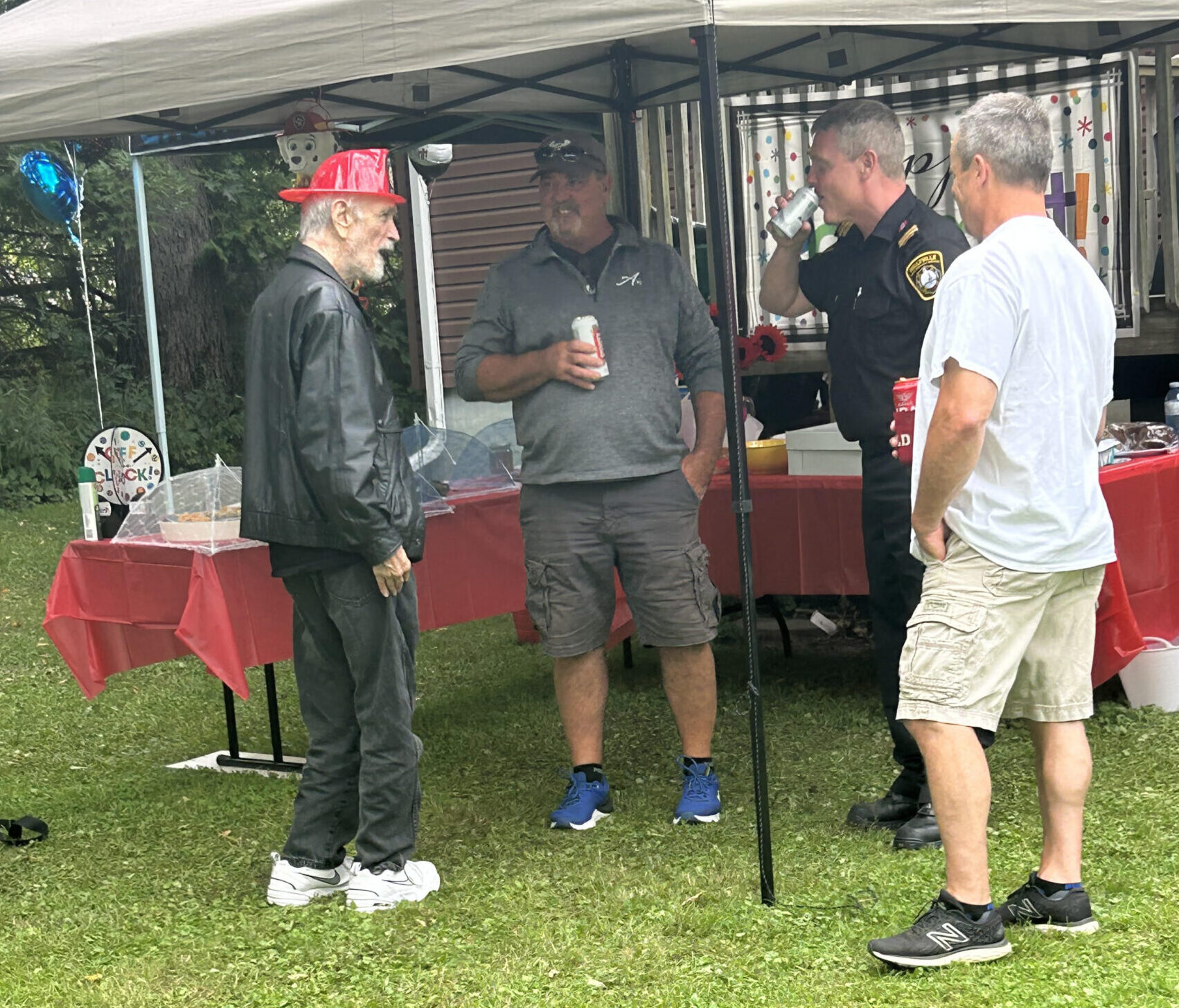
The fire department gave him a shirt, and then a helmet. They let him use their common room for a planning meeting and came in themselves. When his birthday came around, Patrick, with the help of his support workers at CVNQuinte, sent invitations. Nearly a half dozen firefighters showed up at Montana’s to celebrate with him.
One year, they arranged a surprise. After the birthday dinner, a fire truck was waiting outside. They drove Patrick across the bay, even turning the lights on as they approached his home.
“It just has made his life so special,” Joanne says. “Somebody who you never thought would be able to connect to people in the community has developed a beautiful friendship that I think will just continue for a long time.”
The retired firefighter, John, still visits Patrick two or three times a year. His wife comes sometimes too. What began as a thank-you card has become, by any measure, a genuine friendship.
It Doesn’t Happen in a Day
Both Joanne and Jasmine are careful to describe what made this possible, and it was not luck. It was a sustained, intentional effort by support workers who recognized an opening and kept showing up.
“If it wasn’t for the community support workers, Patrick would never have gone to that fire department,” Joanne says. “It was their encouragement to keep going until he did make that connection. Then he started asking to go. At first it was more of a prompted event, but then it eventually became something he wanted to do.”
Jasmine frames it as one of the core responsibilities of the work. “It’s our job to kind of see those moments where you can enter and create that opportunity for community connection and friendships. You want to give everybody the best quality of life possible,” she insists.
Jasmine is also clear-eyed about the timeline. Connection is not something that can be rushed.
“It’s really important to emphasize that you shouldn’t give up. It can be discouraging if you’re trying to build community connections. It’s so important to never, ever give up,” she reflects. “Just because it doesn’t work one time doesn’t mean it’s not going to work another time. Building those connections is not going to happen in a day, but it’s going to happen if you continue to work at it and put your heart and soul into it.”
Joanne reflects on what Patrick gives back to the people who have become his friends.
“He gives them the ability to learn about everyone and accept everyone. And it gives them cheer. To see their smiles when they see him, and Patrick’s reaction to them, it just gives you that warm sense in your heart that this is a true friendship that goes both ways.”
Far More Than They Expected
The fire department’s relationship with Patrick has done something else, too. Jasmine names it directly.
“It shows them, and everybody, that people with disabilities aren’t somebody that you should shy away from. You can build genuine friendships with people who have disabilities.” She adds, “they have just as much to bring to the table as anybody else does.”
For Patrick himself, the outcomes are measurable in ways that go well beyond any framework. Outcome 21 (people realize personal goals) is visible in every birthday party, every visit, every exchange with someone from the firehall. Amazingly, his relationship with the department has endured the slowly evolving members of the crew. It’s a different team, but it’s the same Patrick, and the same relationship.
Joanne puts it simply: “There should be somebody for everybody out there in the world, no matter who you are. And you just never know. This is one of those stories where it was a natural, evolving process that developed this friendship. And it would be nice to see everybody have that opportunity.”
The Measure of a Good Life
Brian runs trains on Tuesday nights. Patrick has birthday parties with firefighters. The details are different; the principle is the same.
At CVNQuinte, Personal Outcome Measures provides the map: a structured, evidence-based way of asking whether the people the agency supports are truly living well across 21 dimensions of a good life. Building Context for Relationship provides the practice as the daily, patient work of finding the places and people where belonging can take root.
Together, they answer a challenge that Terri Korkush says sits at the heart of everything CVNQuinte does. “Building a context for a relationship doesn’t always just stop at friendship, it also helps build opportunities for social roles where people learn to give back in their community and be a part of something they enjoy with others,” she says.
***
Personal Outcome Measures is a registered framework of the Council on Quality and Leadership (CQL). Learn more at c-q-l.org
Durham Association for Family Resources and Supports provides training on “Building a Context for Relationships” at https://dafrs.com/
Read Part One of this series: Where You Belong — Building Context for Relationship.